
Selling and Buying at the Same Time? Here’s Where To Start

By David Torres | Broker Associate, Real Broker
A lot of Lathrop homeowners reach a point where the house they own no longer fits the life they are living.

Maybe the family needs more space.
Maybe the kids have moved out.
Maybe the commute has changed.
Maybe the home has more maintenance than they want.
Maybe they are ready for a different neighborhood, a newer home, or a layout that works better for the next chapter.
Then comes the question that stops a lot of people from moving forward:
“Should we buy first or sell first?”
It is one of the biggest questions homeowners face when they are planning a move.
And there is no one-size-fits-all answer.
The right strategy depends on your finances, your timeline, your comfort level, and the local market. A homeowner selling in Lathrop, CA or River Islands may need a different plan than someone moving in a faster or slower market somewhere else.
But in a lot of cases today, selling first can put you in a stronger position.
That does not mean it is always the right move. But it does solve some of the biggest challenges homeowners face when trying to sell one home and buy another at the same time.
Here is where to start.
Why Selling First May Be the Stronger Move Today
Selling and buying at the same time can feel complicated because you are managing two major decisions at once.
You need to sell your current home for the right price.
You need to find the next home that fits your needs.
You need to line up timing, financing, inspections, appraisals, closing dates, moving logistics, and emotional decisions all at the same time.
That is a lot.
In today’s market, selling can often be the trickier half of the move.
There are more homes for sale than there are buyers in many areas, which means homes may take longer to sell than they did a year or two ago.
That matters.
If your home takes longer to sell than expected, it can affect your finances, your buying power, and your ability to move forward confidently.
Selling first helps clear one of the biggest hurdles before you commit to the next one.
For homeowners in Lathrop and River Islands, this can be especially important because buyers are more selective today. They compare pricing, condition, payment, new construction options, resale competition, and overall value.
So if you are thinking about making a move, starting with the sale may give you a clearer path.
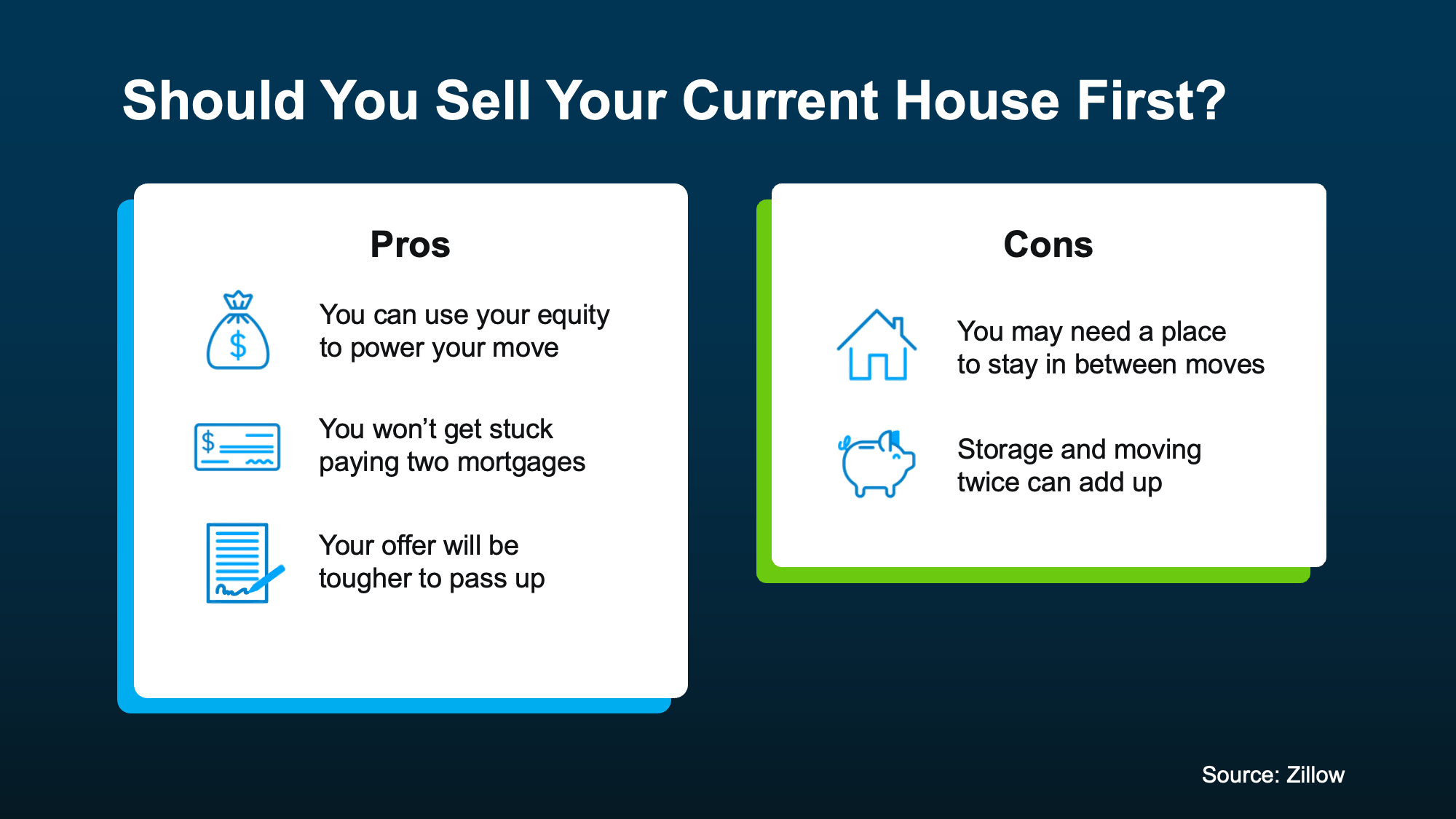
1. You Avoid the Risk of Paying Two Mortgages
One of the biggest risks of buying before selling is carrying two mortgages at the same time.
That may sound manageable for a short period, but it can become stressful quickly.
If your current home takes longer to sell than expected, that overlap could last longer than planned. And if unexpected repairs, price adjustments, or carrying costs come up, the situation can become even more expensive.
That is especially important in a market where homes are not always selling as quickly as they did during the peak years.
Buying first can create pressure.
You may feel rushed to sell.
You may feel forced to accept a lower offer.
You may worry about making two payments.
You may have less flexibility if repairs or negotiations come up.
Selling first helps reduce that risk.
Ramsey Solutions puts it clearly:
“It’s best to sell your old home before buying a new one to avoid unnecessary risks and possible headaches.”
That is the biggest advantage of selling first.
You are not trying to juggle two homes, two payments, and two sets of responsibilities at the same time.
Why This Matters in Lathrop and River Islands
In a market like Lathrop, CA, timing matters.
A home may sell quickly if it is priced correctly, presented well, and positioned clearly. But if it is overpriced, competing with similar listings, or up against builder incentives, it may take longer than expected.
That can be especially relevant in River Islands, where buyers may compare resale homes against other resale listings and tons of new construction options.
If you buy your next home before your current home sells, you may be depending on a timeline you do not fully control.
Selling first gives you certainty.
You know the sale is done.
You know what your proceeds are.
You know what your next budget looks like.
You know you are not carrying two mortgages.
That clarity can make the next step much easier.
2. You Can Use Your Equity To Fuel Your Move
Another major benefit of selling first is that you know exactly how much money you are working with.
That matters because equity often plays a major role in the next purchase.
Equity is the difference between what your home is worth and what you still owe on your mortgage.
For many homeowners, that number can be significant.
According to Realtor.com, homeowners who have been in their home for five years have about $180,000 in equity on average.
Homeowners who have owned their home for six to ten years have over $340,000 in equity on average.
That equity can become the fuel for your next move.
After you sell, you may be able to use those proceeds for:
- a larger down payment
- a stronger offer
- lower monthly payment
- paying off debt
- covering closing costs
- buying your next home with more confidence
- possibly buying in cash, depending on your situation
That is a major advantage.
Instead of guessing how much you may have available, selling first gives you a real number.
That helps you plan the next purchase with more accuracy.
How Equity Can Change Your Buying Power
For a homeowner in Lathrop or River Islands, equity can open up options.
Maybe you bought several years ago and your home has appreciated. Maybe you have paid down your loan. Maybe both things are true.
That equity may help you move up, downsize, relocate, or purchase a home that better fits your life today.
It may also help make the monthly payment more manageable.
A larger down payment can reduce the loan amount. That can lower the monthly mortgage payment and may make it easier to qualify.
It can also make your offer stronger.
Sellers want to see buyers who are financially solid. If you are using proceeds from a completed sale, you may look more prepared than a buyer who still needs to sell their current home.
That can matter in negotiations.
3. Your Offer May Be Harder To Pass Up
When your current home is already sold, your next offer can become much cleaner.
You do not have to make your offer contingent on the sale of your existing home.
That is a big deal.
From the seller’s perspective, a home sale contingency can create uncertainty. If your current home does not sell, their sale may be delayed or fall apart. Many sellers prefer buyers who do not have that extra layer of risk.
If your house is already sold, your offer may feel more reliable.
And in a market where buyers are taking their time, sellers may gravitate toward the offer most likely to close smoothly.
Think about it from the seller’s side.
If their house has been sitting for a while, they may care about more than price. They may care about certainty. They may want a buyer who is ready, qualified, and not dependent on another sale happening first.
That can put you in a stronger negotiating position.
You may also have room to ask for reasonable terms, such as repairs, credits, closing cost help, or timing flexibility, depending on the situation.
A motivated seller may prefer keeping a strong buyer moving forward rather than going back to the market and waiting for another offer.
Why a Cleaner Offer Matters Locally
In Lathrop and River Islands, buyers are often comparing multiple options.
Some homes may sit longer. Some sellers may be more flexible. Others may still receive strong interest if the home is priced well and shows well.
A clean offer can matter in either situation.
If there is competition, a non-contingent offer can help you stand out.
If the seller is motivated, a strong and clean offer may give you more negotiating room.
If the property has been sitting, certainty may be more appealing than a slightly higher but riskier offer.
This is where strategy matters.
The strongest offer is not always just the highest price.
Sometimes the strongest offer is the one that gives the seller confidence it will close.
Is There a Catch to Selling First?
Yes.
Selling first can be a smart move, but it does come with tradeoffs.
The biggest concern is where you will live between selling your current home and buying the next one.
You may worry about:
- needing temporary housing
- moving twice
- storage costs
- timing the next purchase
- finding the right replacement home
- feeling rushed after your home sells
These concerns are real.
But many of them can be managed with the right plan.
The key is to talk through these tradeoffs before you list your home.
A strong agent can help you plan around timing, negotiate flexible terms, and reduce the chances of feeling stuck between homes.
How To Manage the Transition
If you decide to sell first, there are ways to make the transition smoother.
One option is a rent-back agreement.
A rent-back allows you to stay in your home for a set period after closing. This can give you extra time to find and close on your next home without having to move immediately.
Another option is negotiating a flexible closing date.
If the buyer is flexible, you may be able to structure the timeline so the sale of your current home and purchase of your next home line up more smoothly.
You can also prepare in advance by:
- getting your home market-ready before listing
- speaking with a lender early
- understanding your expected equity
- identifying target neighborhoods
- watching replacement inventory
- knowing your must-haves
- planning for temporary housing only if needed
The goal is not to wing it.
The goal is to build a transition plan before the home goes on the market.
Should You Buy First Instead?
There are situations where buying first may make sense.
For example, buying first may be worth considering if:
- you have enough cash reserves to carry both homes temporarily
- you qualify for the next home without selling first
- you find a rare home you do not want to miss
- your current home is likely to sell quickly
- your move requires very specific timing
- you have bridge financing or another financial strategy available
Buying first can reduce the risk of being between homes, but it can increase financial pressure.
That is why the decision should not be made based on fear alone.
It should be made after reviewing the numbers and the local market.
If you can comfortably carry both homes and the right property becomes available, buying first may be an option.
But if carrying two mortgages would create stress or force a rushed sale, selling first may be safer.
Should You Sell First or Buy First?
Selling first is often the stronger move when your next purchase depends on the proceeds from your current home, when homes are taking longer to sell, or when you want to avoid the risk of carrying two mortgages. Buying first may make sense if you can comfortably afford both homes temporarily or if you find a rare replacement property. For homeowners in Lathrop and River Islands, the best choice depends on your equity, financing, timeline, and the local market.
What Lathrop Homeowners Should Review First
Before deciding whether to sell first or buy first, start with the facts.
You need to know:
- your estimated home value
- your remaining mortgage balance
- your estimated equity
- your net proceeds after selling costs
- your next home budget
- whether you qualify before or after selling
- how long similar homes are taking to sell
- what replacement homes are available
- how competitive your target market is
- your comfort level with timing and temporary housing
This is where a local strategy conversation helps.
A homeowner in River Islands may need to account for resale competition, builder inventory, buyer demand, and the current pricing environment.
A homeowner in another part of Lathrop may have a different set of comparable sales, buyer expectations, and timing considerations.
The strategy should match the property and the next move.
Selling First Can Give You More Confidence
One of the hardest parts of selling and buying at the same time is uncertainty.
You do not want to sell and have nowhere to go.
You do not want to buy and be stuck with two mortgages.
You do not want to miscalculate your proceeds.
You do not want to feel rushed into the wrong home.
Selling first can help remove some of that uncertainty.
It gives you a clearer financial picture. It can strengthen your next offer. It can reduce the risk of carrying two payments. And it can help you move forward knowing your current home sale is already handled.
That peace of mind matters.
A move is not just a transaction. It affects your family, your finances, your schedule, and your next chapter.
The right plan can make the process feel much more manageable.
Bottom Line
There is no one-size-fits-all answer to selling and buying at the same time.
But for many homeowners, selling first can make the move easier on both the mind and the wallet.
It can help you avoid two mortgages, unlock your equity, and make your next offer stronger because it is not dependent on selling your current home.
According to Realtor.com, homeowners who have been in their home for five years have about $180,000 in equity on average, and those who have owned for six to ten years have over $340,000. That equity can be a powerful tool for your next move.
If you are thinking about selling and buying in Lathrop, CA or River Islands, the best place to start is with a clear plan.
Let’s look at your current home value, your equity, your next-home budget, and the local market so you can make the move with more confidence, more financial power, and less stress.
About the Author
David Torres is a Broker Associate at Real Broker serving Lathrop, CA and River Islands. He helps homeowners plan smart moves, understand their equity, and navigate selling and buying with local strategy and confidence.
Categories
Recent Posts