Here’s Why Mortgage Rates Are What They Are Right Now

By David Torres | Broker Associate, Real Broker
A buyer in Lathrop recently asked a question that a lot of people are probably thinking.
“Why are mortgage rates still where they are?”

That question matters because mortgage rates affect almost everything about the buying decision.
They affect your monthly payment.
They affect your buying power.
They affect which homes feel affordable.
They affect whether you keep searching or decide to wait.
And if you are looking at homes in Lathrop, CA or River Islands, the difference between one rate and another can change the entire conversation.
A lot of buyers are still waiting for mortgage rates to fall dramatically before they buy. That is understandable. Lower rates would help affordability and make monthly payments feel more manageable.
But based on what is happening behind the scenes, rates may not drop as much as some buyers are hoping.
There is one number that helps explain why.
It is called the spread.
Once you understand what the spread is and how it affects mortgage rates, today’s market may make a little more sense.
Why Are Mortgage Rates What They Are Right Now?
Mortgage rates are where they are right now because they are heavily influenced by the 10-year Treasury yield, inflation, economic uncertainty, investor demand, Federal Reserve policy, and the spread between the 10-year Treasury yield and mortgage rates.
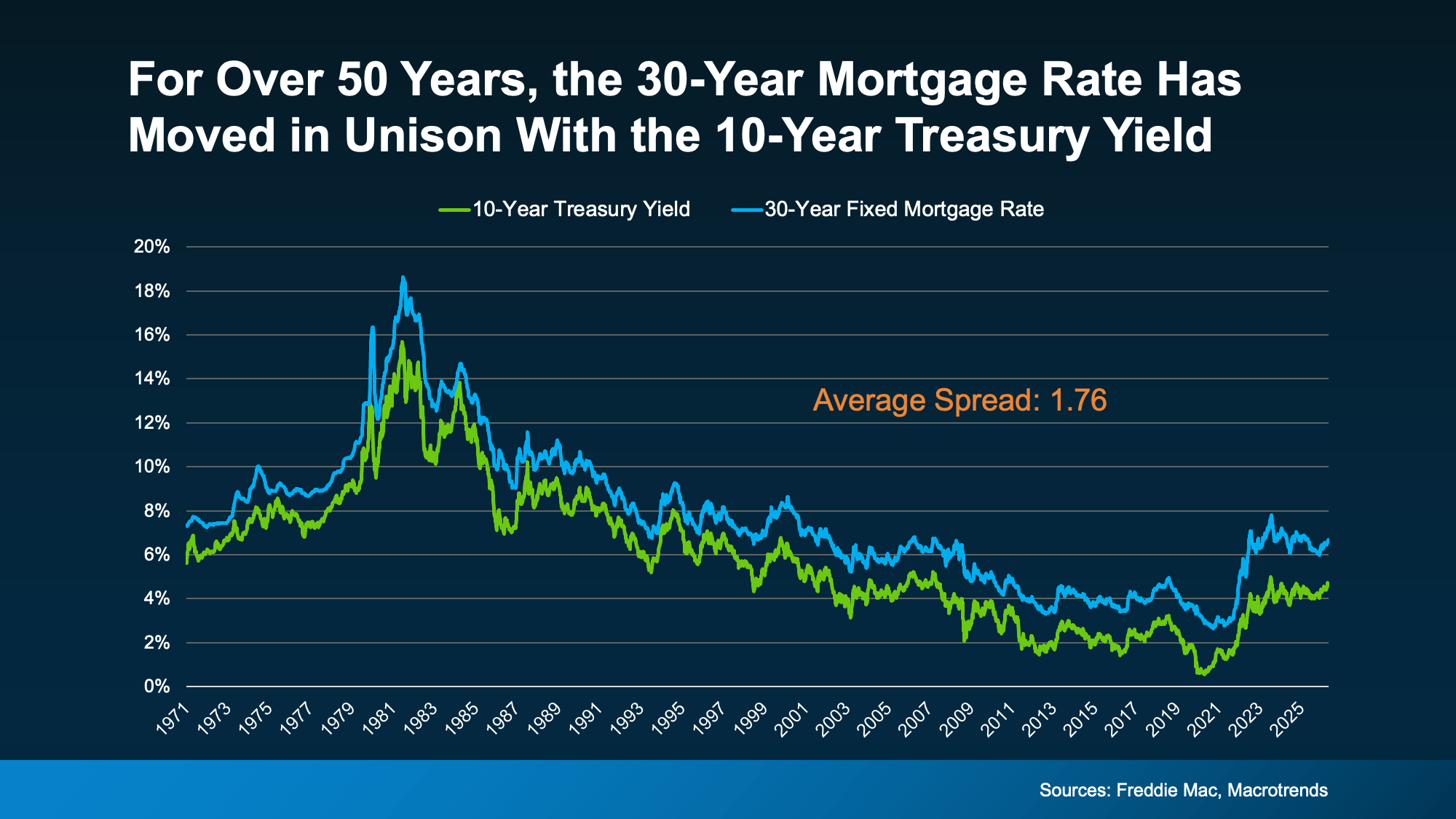
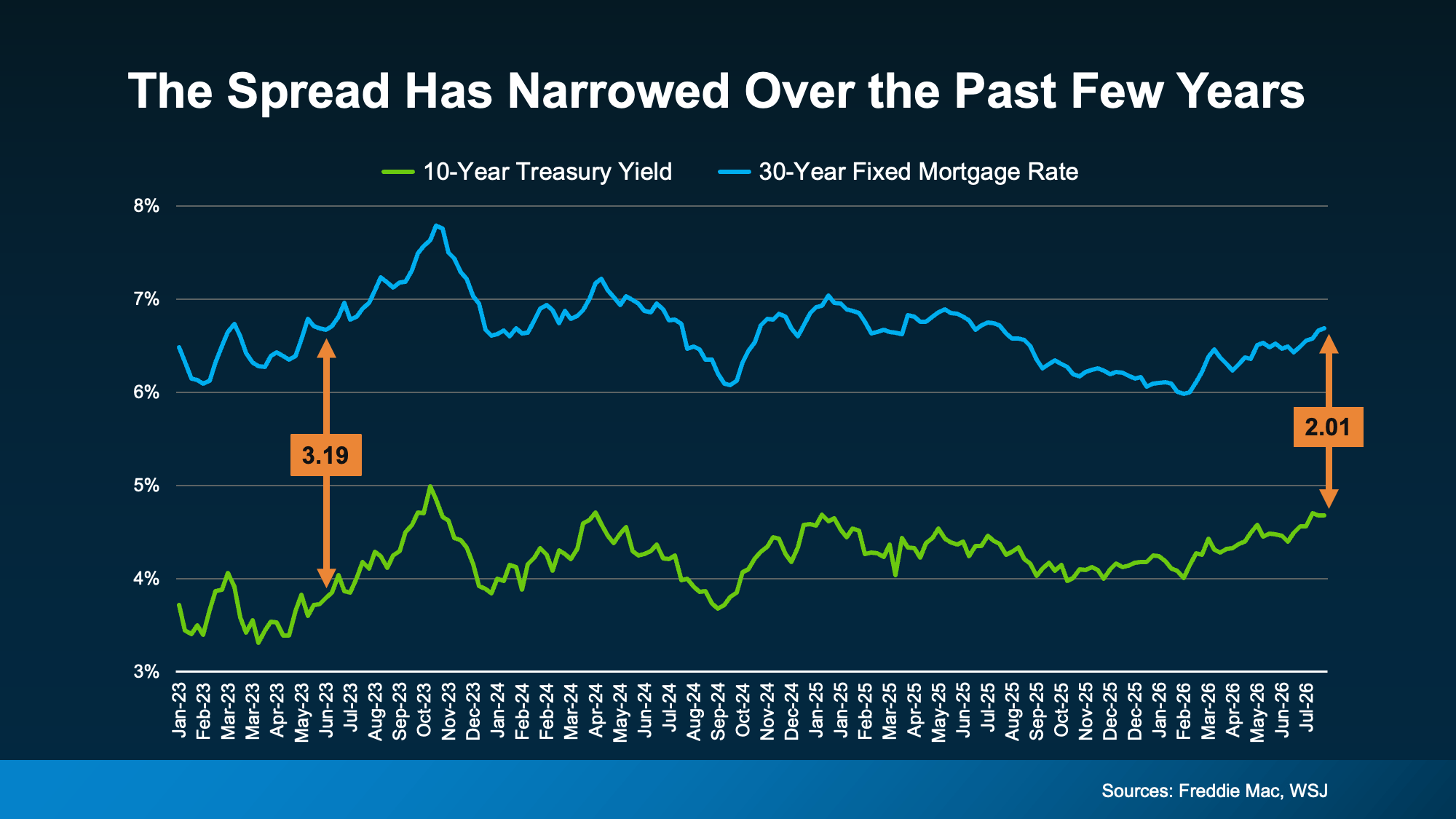
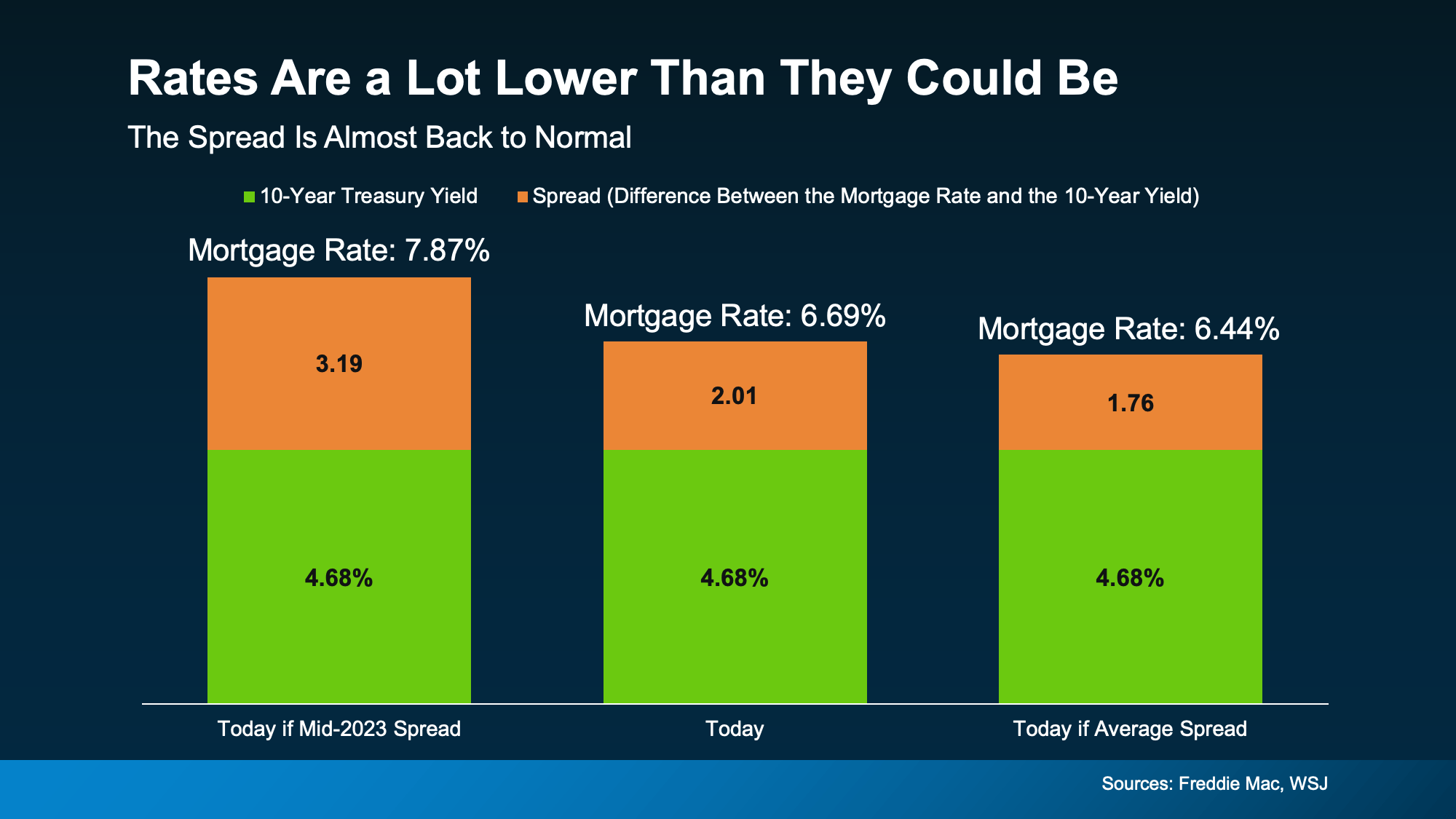
Historically, mortgage rates and the 10-year Treasury yield have moved closely together. Today, the spread has narrowed from its 2023 high of 3.19 percentage points to about 2.01, which is helping keep mortgage rates closer to 6.69% instead of near 8%.
But because the spread is already closer to its long-term average of 1.76, rates may not have much more room to fall from the spread alone.
That is the short version.
Now let’s break down what that actually means if you are trying to buy a home in Lathrop or River Islands.
The Pattern That Has Held for More Than 50 Years
Mortgage rates do not move on their own.
They tend to follow the 10-year Treasury yield, which is a number tied to how investors feel about the economy.
It is not an exact one-to-one relationship because there are many other factors that can move mortgage rates day to day. But broadly speaking, mortgage rates and the 10-year Treasury yield have moved together for decades.
When the economy looks strong, the 10-year Treasury yield tends to climb over time.
When the economic outlook feels uncertain, that yield tends to ease.
For more than 50 years, the 10-year Treasury yield and mortgage rates have moved almost in lockstep.
That relationship is important because it helps explain why mortgage rates are where they are today.
But the Treasury yield is only part of the story.
The other part is the gap between the 10-year Treasury yield and the mortgage rate.
That gap is called the spread.
What Is the Mortgage Rate Spread?
The mortgage rate spread is the difference between the 10-year Treasury yield and the mortgage rate buyers are offered.
On average, that gap has historically been about 1.76 percentage points.
That spread matters because it helps determine the rate buyers actually see when they apply for a mortgage.
A wider spread tends to push mortgage rates higher than the Treasury yield alone would suggest.
A narrower spread keeps mortgage rates closer to the Treasury yield.
Here is a simple way to think about it.
Mortgage rates are influenced by the 10-year Treasury yield, but lenders and investors also account for risk, market uncertainty, demand for mortgage-backed securities, inflation expectations, and overall economic conditions.
The spread reflects those extra layers.
So when the spread gets wider, mortgage rates can feel higher than expected.
When the spread narrows, mortgage rates may improve even if the Treasury yield does not move much.
That is exactly why this matters for buyers.
Why Mortgage Rates May Not Drop Dramatically Soon
If you are hoping mortgage rates will drop a lot soon, here is the reality:
They may not.
At least not in a dramatic way.
One of the biggest reasons comes back to the spread between the 10-year Treasury yield and mortgage rates.
A few years ago, that gap widened significantly as economic uncertainty increased. In 2023, the spread rose as high as 3.19 percentage points.
That was unusually wide.
When the spread is that large, mortgage rates are pushed much higher than the Treasury yield alone would suggest.
But recently, the spread has narrowed.
It is now down to about 2.01 percentage points, which is only slightly above the long-term average of 1.76 percentage points.
That narrowing has helped mortgage rates improve from where they could have been.
But it also means there may be less room for rates to fall from this specific factor.
When the spread is very wide, there is more room for mortgage rates to come down if that spread narrows.
But when the spread is already closer to normal, there is less extra room left for improvement.
That is why buyers should be careful about assuming rates are about to drop dramatically.
The spread has already done a lot of the work.
Why Mortgage Rates Are Not Higher Right Now
Here is the part that many buyers miss.
The narrowing spread is actually good news.
Today’s mortgage rate is basically the 10-year Treasury yield plus the spread. So when either number moves, mortgage rates can move too.
Using the example from the KCM data, today’s 10-year Treasury yield is 4.68%.
That helps explain three possible mortgage rate scenarios.
[INSERT IMAGE: KCM graph showing three mortgage rate scenarios based on today’s 10-year Treasury yield of 4.68% and different spread levels]
If the spread were still as wide as it was in 2023, mortgage rates would be pushing close to 8% right now.
That is because the spread was more than a full point wider than it is today.
But because the spread has narrowed recently, today’s mortgage rate is around 6.69%.
That is a meaningful difference.
For buyers in Lathrop and River Islands, a rate closer to 6.69% versus nearly 8% can create a major difference in monthly payment and affordability.
That is why Logan Mohtashami, Lead Analyst at HousingWire, described better mortgage spreads in 2026 as the housing hero story of the year.
In simple terms, the spread narrowing has helped keep rates from being much worse.
That is the good news.
The not-so-good news is that if the spread were sitting at its exact long-term average, mortgage rates would be around 6.5%.
That is only about a quarter of a point away from where rates are now.
So most of the improvement buyers could realistically expect from a shrinking spread has already happened.
In other words, the same narrowing spread that is helping keep rates from being close to 8% is also one of the reasons they may not fall much further.
Can Mortgage Rates Still Come Down?
Yes, mortgage rates can still come down, but a dramatic drop is not guaranteed.
Mortgage rates are influenced by inflation, Treasury yields, Federal Reserve policy, global events, investor demand, and overall economic conditions.
But since the spread between the 10-year Treasury yield and mortgage rates has already narrowed significantly, buyers should not rely only on a major rate drop to improve affordability.
For buyers in Lathrop, CA and River Islands, the better strategy is to understand what today’s rates mean for your monthly payment and compare the options that may be available right now.
That could include seller credits, rate buydowns, builder incentives, assumable mortgages, or adjusting the search based on your actual payment comfort zone.
What Does the Mortgage Rate Spread Mean for Homebuyers?
The mortgage rate spread matters because it directly affects the rate buyers pay on a home loan. When the spread is wider, mortgage rates are higher than the 10-year Treasury yield alone would suggest. When the spread narrows, mortgage rates can move closer to the Treasury yield. Today, the spread has narrowed from 3.19 in 2023 to about 2.01, which is helping keep rates lower than they could be, but also means there may be less room for rates to fall much further from spread improvement alone.
That is why waiting for a big rate drop can be risky.
Rates may still improve. But if the biggest source of recent improvement has already happened, the next major move may depend on other factors like inflation, the economy, Federal Reserve policy, and investor confidence.
What This Means for Buyers in Lathrop
If you are buying in Lathrop, CA, this matters because your payment depends on more than the home price.
Mortgage rates directly affect affordability.
A higher rate can reduce your buying power.
A lower rate can improve your monthly payment.
A small difference in rate can affect how comfortable the numbers feel.
That is why so many buyers are watching mortgage rates closely.
But waiting for a major rate drop may not be the best strategy if the forecast and spread data do not support a dramatic decline.
The better approach is to understand what you can afford in today’s market and explore strategies that may help make the payment work.
That could include:
- comparing resale and new construction options
- asking about seller credits
- looking into rate buydowns
- reviewing different loan programs
- comparing monthly payment scenarios
- watching price reductions
- evaluating assumable mortgage opportunities
- looking at homes that have been sitting longer
- adjusting the search based on your true payment comfort zone
The goal is not to ignore rates.
The goal is to make decisions based on what is actually happening, not what you hope may happen later.
What This Means for River Islands Buyers
For buyers looking in River Islands, mortgage rates can play an even bigger role because many homes are newer and may come with additional cost considerations.
Depending on the property, buyers may need to account for:
- property taxes
- HOA dues
- special assessments or Mello-Roos, if applicable
- solar structure
- insurance
- landscaping
- upgrades
- maintenance
- new construction incentives
- resale versus builder inventory
That means the interest rate is only one part of the full monthly payment.
A buyer may focus on the mortgage rate and miss other details that affect affordability just as much.
For example, a resale home with completed landscaping, window coverings, upgrades, and owned solar may compare differently than a new construction home with builder incentives but added upgrade costs or different monthly obligations.
That is why buyers should look at the full financial picture, not just the rate.
The best strategy is to compare real options side by side.
Should You Wait for Mortgage Rates To Drop Before Buying?
Waiting for mortgage rates to drop may make sense if your current payment would not be comfortable or if you need more time to prepare financially. But if you are waiting only because you expect a dramatic rate drop, that may not be the strongest strategy. Since the mortgage rate spread has already narrowed significantly, rates may not fall much further from spread improvement alone. Buyers in Lathrop and River Islands should compare today’s payment options, inventory, seller credits, and local market conditions before deciding to wait.
Waiting can make sense in some situations.
If your payment is not comfortable, if you need to save more, if your job situation is uncertain, or if you are not financially ready, waiting may be the right move.
But waiting only because you expect mortgage rates to fall sharply could be risky.
Here is why.
If rates do not fall much, you may spend another year on the sidelines without improving your position.
If home prices continue rising, the home you want may become more expensive.
If rates dip even slightly and more buyers come back into the market, competition may increase.
If inventory changes, the home that fits your needs may not be available later.
So the question is not simply:
“Should I wait for lower rates?”
The better question is:
Will waiting actually put me in a better position?
That answer depends on your budget, timeline, goals, and the local market.
How Buyers Can Improve Affordability Without Waiting for Rates To Fall
If rates do not fall dramatically, buyers still have options.
The right option depends on the home, the seller, the lender, and your long-term plans.
Here are a few strategies worth reviewing.
Seller Credits
Some sellers may be open to offering a credit toward closing costs or a rate buydown.
This can help reduce the amount of cash you need at closing or improve your monthly payment.
In a market where buyers are more payment-sensitive, seller credits can sometimes be more valuable than a simple price reduction.
Rate Buydowns
A rate buydown allows money to be paid upfront to lower the buyer’s interest rate.
This can be temporary or permanent, depending on the structure.
A buydown may be paid by the buyer, negotiated with the seller, or offered through a builder incentive.
New Construction Incentives
Builders sometimes offer incentives to attract buyers.
Those incentives may include rate buydowns, closing cost credits, free upgrades, or pricing adjustments.
For buyers comparing resale homes and new construction in or around Lathrop and River Islands, these incentives should be reviewed carefully.
The key is to compare the full cost, not just the advertised incentive.
Assumable Mortgages
An assumable mortgage allows a buyer to take over the seller’s existing loan, including its interest rate, if the loan and buyer qualify.
This can be valuable if the seller has a lower rate than what is currently available.
Not every loan is assumable, and there may be a gap between the loan balance and the purchase price that must be covered. But it can be worth asking about.
Adjusting the Search
Sometimes the best affordability strategy is adjusting the search.
That could mean considering a different neighborhood, a smaller home, a townhome, a condo, a resale home instead of new construction, or a property that needs light cosmetic work.
The goal is not to settle.
The goal is to find the right balance between payment, lifestyle, and long-term fit.
What Sellers Should Understand About Rates
Mortgage rates do not only affect buyers.
They affect sellers too.
When rates are higher, buyers become more payment-sensitive. That can affect showing activity, offer strength, negotiation, and days on market.
Sellers in Lathrop and River Islands should understand that buyers are looking closely at the total monthly cost.
That means pricing matters. Presentation matters. Marketing matters. Flexibility may matter too.
If buyers are already stretched by rates, they may be more likely to ask for:
- closing cost credits
- rate buydown assistance
- repairs
- price adjustments
- concessions
- flexible terms
That does not mean sellers have to agree to everything.
But it does mean sellers should understand how rates influence buyer behavior.
A strong seller strategy should account for affordability.
Sometimes a credit toward a rate buydown may be more attractive to a buyer than a simple price reduction, depending on the numbers. Sometimes the better strategy is to price more accurately from the start. Sometimes a seller needs to stand firm if the home is priced correctly and demand is strong.
The right approach depends on the property and the local market.
How To Think About Your Next Move
Whether you are buying or selling, the biggest mistake is making decisions based only on rate headlines.
Mortgage rates matter, but they are not the entire picture.
For buyers, the key questions are:
- What monthly payment is comfortable?
- What homes fit that payment today?
- What loan options are available?
- Would a rate buydown help?
- Are sellers offering credits?
- Are builders offering incentives?
- How long do you plan to own the home?
- What happens if rates do not fall much?
For sellers, the key questions are:
- How are rates affecting buyer demand in your price range?
- Are similar homes sitting longer?
- Are buyers asking for credits or concessions?
- Would your pricing strategy attract serious buyers?
- How does your home compare to the competition?
- Could better positioning help offset buyer affordability concerns?
The goal is to move with strategy, not guesswork.
Bottom Line
That is the tradeoff with a narrowing spread.
Mortgage rates may not be where buyers want them to be, but they are better than they could have been.
The spread between the 10-year Treasury yield and mortgage rates reached as high as 3.19 percentage points in 2023. Recently, it has narrowed to about 2.01, much closer to the long-term average of 1.76.
Because of that, mortgage rates are around 6.69% instead of pushing close to 8%. But since the spread is already much closer to normal, buyers should not assume rates are likely to fall dramatically from this factor alone.
If you are thinking about buying in Lathrop, CA or River Islands, the smartest move is to understand what today’s rates mean for your actual monthly payment.
If you want to compare options, look at affordability strategies, or understand what is happening in the local market, reach out. I can help you look at the numbers clearly and connect you with a trusted local lender who can walk through payment scenarios with you.
About the Author
David Torres is a Broker Associate at Real Broker serving Lathrop, CA and River Islands. He helps buyers and sellers understand local market trends, home values, mortgage rate impacts, and real estate strategy so they can make confident decisions in today’s market.
Categories
Recent Posts