Data Centers Are Moving Closer to Homes. What Does That Mean for Lathrop Buyers and Homeowners?
By David Torres | Broker Associate, Real Broker
When most people think about what could affect a home purchase, they usually think about the obvious things.
School districts.
Commute times.
Nearby shopping.
Parks.
Traffic.
How close they are to family.
A large building filled with computer servers probably is not high on the list.
But that may be changing.
Data centers are being built in more communities across the country, and as they move closer to residential areas, more buyers and homeowners are asking questions.
Could a nearby data center affect home values?
Will it make the area noisier?
Could it change utility costs?
Will it bring more development and infrastructure?
And if one is proposed near a neighborhood you are considering, should that change your decision?
The answer is not as simple as saying data centers are good or bad.
There are tradeoffs.
And as this type of development becomes more common, buyers and homeowners in Lathrop, CA, River Islands, and surrounding areas may want to understand what to look for.
Are Data Centers Being Built Closer to Homes?
Yes.
Data centers are appearing in significantly more ZIP codes than they were just a decade ago.
According to Realtor.com, only about a dozen ZIP codes had a large data center in 2015.
By the first half of 2026, that number had climbed to more than 100 ZIP codes, and it is projected to rise further by the end of the year.
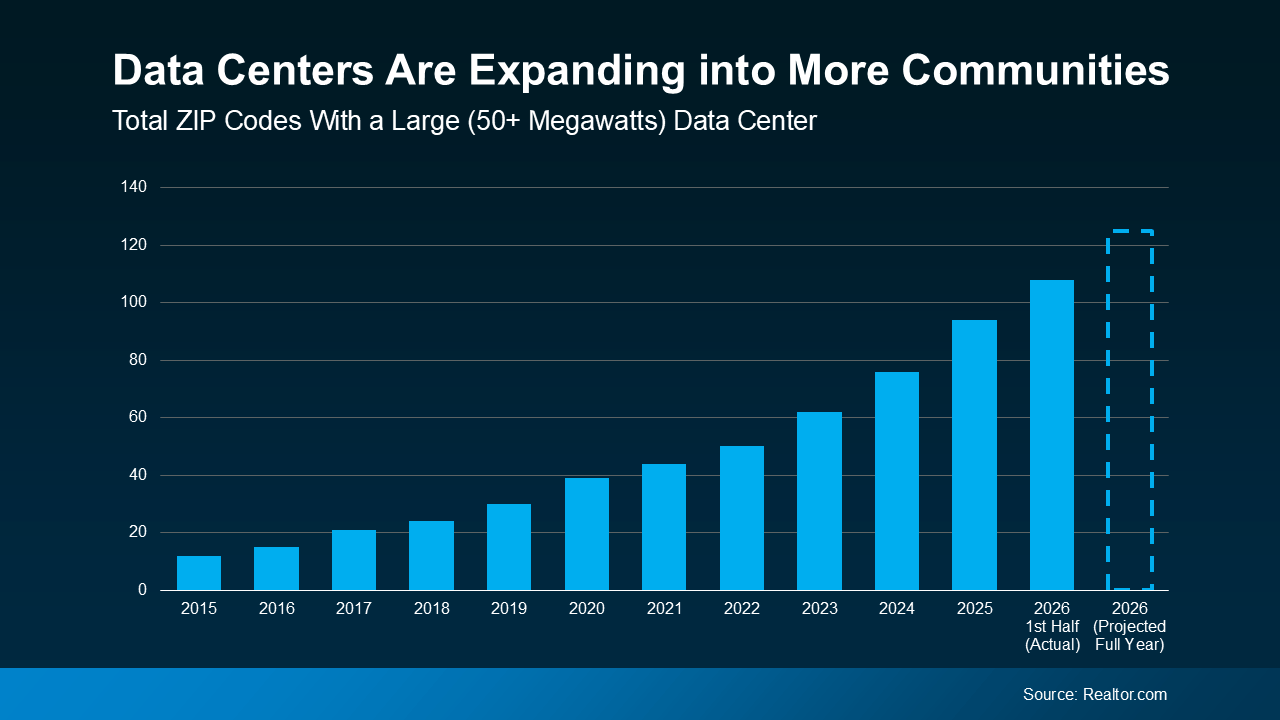
That is a major increase in a relatively short period of time.
HousingWire reports much of that growth is happening in states including:
- Texas
- Virginia
- Georgia
- Pennsylvania
- Ohio
- Utah
- Illinois
- Arizona
- Indiana
- Nevada
That growth helps explain why data centers are becoming a real estate conversation.
More buyers are going to encounter them during a home search.
More homeowners are going to hear about facilities being proposed or approved nearby.
And naturally, people want to know what those developments could mean for the homes around them.
What Is a Data Center?
A data center is a facility designed to house large amounts of computer equipment, servers, networking hardware, and digital infrastructure.
They help support many of the online services people use every day.
That includes things like:
- cloud computing
- streaming
- websites
- online shopping
- artificial intelligence
- financial systems
- business software
- data storage
- internet services
These facilities can be very large and may require significant electrical infrastructure, cooling systems, backup generators, fiber connections, and security.
That is why a data center can look and operate very differently from a typical office building or warehouse.
And those differences are what homeowners and buyers may want to pay attention to.
Do Data Centers Hurt Nearby Home Values?
So far, research does not show that simply having a large data center nearby automatically causes home values to fall.
Researchers have compared communities with large data centers to similar communities without them.
According to reporting from HousingWire, home values in ZIP codes with data centers generally tracked comparable communities and showed no statistically meaningful gains or losses.
Listing prices showed a modest initial increase around data center openings, but the larger point is that the presence of a data center alone has not historically been enough to dramatically raise or lower nearby home values.
That is important.
It means homeowners should not automatically assume a proposed data center will hurt their property value.
But it also does not mean every property will react exactly the same way.
Location still matters.
A home immediately next to a large industrial facility may be perceived differently from a home several miles away.
Other factors can include:
- visibility of the facility
- noise
- traffic
- nearby transmission lines
- substations
- construction activity
- future commercial development
- distance from residential areas
- landscaping or buffering around the site
So far, the data does not support a blanket conclusion that data centers automatically reduce home values.
But buyers should still evaluate the specific property and location.
Could a Data Center Affect Home Values in Lathrop?
A data center by itself would not necessarily determine whether a home in Lathrop gains or loses value.
Home values are influenced by many factors, including supply and demand, location, condition, school access, neighborhood appeal, interest rates, local employment, and the broader housing market.
If a large data center or similar development were proposed near a residential area, the specific location and design would matter.
For example, a buyer may react differently to a facility that is:
- several miles away
- separated by commercial development
- screened by landscaping
- adjacent to a freeway or industrial area
versus one that is:
- directly behind homes
- highly visible
- connected to new transmission infrastructure
- generating noticeable noise
- creating increased truck or construction traffic
That is why buyers should look at more than the headline.
They should understand the actual development plan.
Data Centers Can Be Part of a Bigger Growth Story
There can also be benefits.
A major data center development may be part of broader economic growth in an area.
Large facilities can generate substantial property tax revenue.
That revenue may support local services and infrastructure depending on how the project is structured and how local governments allocate those funds.
A large development may also lead to additional investment nearby.
That can include:
- roads
- electrical infrastructure
- fiber networks
- utility improvements
- commercial development
- supporting businesses
For growing communities, infrastructure investment can sometimes be significant.
That does not mean every resident will directly benefit from every project.
But buyers and homeowners should understand that large developments can have economic effects beyond the physical building itself.
Data Centers Can Generate Economic Activity
Another potential benefit is economic activity.
Data centers can create jobs during construction and ongoing operations.
Those jobs can support local businesses, increase economic activity, and potentially contribute to housing demand.
The total employment impact varies by facility.
Some data centers may create substantial construction employment but fewer permanent positions once completed.
Others may become part of a larger technology or logistics ecosystem that attracts additional employers.
So if a data center is proposed in an area, it can be useful to look beyond the facility itself.
Ask what other development may follow.
The Tradeoff: Data Centers Are Not Invisible
One of the most obvious concerns is appearance.
Data centers can be large.
Depending on the project, buyers and homeowners may see:
- large industrial-style buildings
- substations
- electrical infrastructure
- transmission lines
- backup generators
- security fencing
- construction equipment
- truck traffic
That can change the visual character of an area.
For some buyers, it may not matter much.
For others, especially those choosing a home because of views or a quieter residential setting, it could matter considerably.
This is why proximity is important.
A data center several miles away may have little noticeable effect on daily life.
A facility directly adjacent to a residential neighborhood could create a very different experience.
Can Data Centers Be Noisy?
Yes, depending on the facility and how close you are.
Data centers use cooling systems to keep computer equipment from overheating.
They may also use:
- large fans
- cooling equipment
- backup generators
- electrical equipment
- truck traffic
During construction, there may also be additional noise from equipment and vehicles.
How noticeable that noise is depends on several factors.
Those include:
- distance from homes
- facility design
- sound barriers
- landscaping
- terrain
- operating equipment
- local noise regulations
A buyer considering a home near a data center should not assume noise will be a problem.
But it is reasonable to investigate.
Visiting the area at different times of day can also help buyers understand what the location actually feels like.
Do Data Centers Increase Electricity Bills?
Data centers use large amounts of electricity.
That has raised concerns about whether increased demand could contribute to higher electricity costs for nearby residents.
The answer depends on the utility market, regulations, infrastructure investments, and how costs are allocated.
J.P. Blackwood, Public Affairs Liaison and Media Spokesperson for the Ohio Consumers’ Counsel, explained that utility rate increases tend to happen gradually and that data centers are one of several factors that can influence electricity prices.
He also noted that steps are being taken in different parts of the country to reduce the impact on consumers.
The important word here is can.
A data center can contribute to growing electricity demand.
But that does not mean a facility automatically causes residential utility bills to rise.
Utility costs are affected by many factors.
Those can include:
- fuel prices
- power generation costs
- transmission infrastructure
- utility regulations
- weather
- renewable energy investments
- grid upgrades
- demand growth
So buyers and homeowners should avoid assuming a direct one-to-one relationship.
The local utility structure matters.
Do Data Centers Use a Lot of Water?
Some do.
Data centers can require significant water depending on the type of cooling system they use.
Other facilities may use different cooling technologies that reduce water consumption.
This is another reason the details of the individual project matter.
In areas where water supply is already an important issue, residents may understandably want to know how much water a proposed facility will use.
Questions to ask could include:
- What cooling system will the facility use?
- How much water is projected to be consumed?
- Where will that water come from?
- Will recycled water be used?
- Are there local restrictions or mitigation requirements?
Those answers may vary substantially from one development to another.
What Should Buyers Do if a Data Center Is Nearby?
If you are buying a home and there is a data center nearby or one being proposed, do some research before making a decision.
Look at what already exists and what has been approved.
Consider:
- how close the facility is
- whether it is visible from the property
- expected construction timeline
- potential noise
- traffic changes
- transmission lines or substations
- planned road improvements
- utility infrastructure
- future commercial development
Also look at local planning information.
A vacant parcel today may already have an approved project attached to it.
That is why buyers should not evaluate only what they see when touring the home.
Future development matters too.
What Should Lathrop and River Islands Buyers Look For?
For buyers in Lathrop and River Islands, future development should already be part of the home search.
These are growing areas.
New homes, roads, commercial development, infrastructure, and community amenities can change over time.
Before buying, it may be worth reviewing:
- nearby zoning
- approved development
- proposed commercial projects
- road expansions
- utility infrastructure
- vacant parcels
- future phases of development
This does not mean every future project is a negative.
Growth can bring amenities, roads, businesses, jobs, and infrastructure.
The goal is simply to understand what may be coming.
A buyer should know as much as reasonably possible before purchasing.
What Should Sellers Do if There Is a Data Center Nearby?
If you are selling a home near a data center, do not automatically assume it hurts your property value.
The available research does not show that data centers automatically cause nearby home values to decline.
But buyers may still have questions.
That means sellers should know the facts.
Be prepared to understand:
- how far away the facility is
- whether it is operational or proposed
- construction timeline
- expected traffic
- noise mitigation
- nearby infrastructure plans
- future development
The goal is not to minimize a buyer’s concerns.
It is to answer them with accurate information.
Uncertainty can create more hesitation than the development itself.
If buyers understand exactly what is there, they can make their own decision about whether it matters to them.
Are Data Centers Good or Bad for Nearby Homeowners?
Data centers are not automatically good or bad for nearby homeowners.
They can bring tax revenue, infrastructure investment, economic activity, and development. But they can also introduce concerns about appearance, noise, electricity demand, water use, construction, and traffic.
Research so far does not show a consistent negative impact on home values simply because a data center is located in the ZIP code.
The actual impact depends heavily on the location, facility design, proximity to homes, local infrastructure, and how the community manages the development.
That is why buyers and homeowners should evaluate each project individually.
Will a Data Center Lower My Home Value?
Not necessarily.
Current research does not show that large data centers automatically lower nearby home values. HousingWire reported that home values in ZIP codes with data centers generally tracked similar communities without them, with no statistically meaningful gains or losses.
However, an individual property's value may still be affected by factors such as proximity, noise, traffic, visibility, electrical infrastructure, and surrounding development.
The closer the property is to the facility, the more important those details may become.
Should You Buy a Home Near a Data Center?
Buying a home near a data center can still make sense if the property fits your budget, lifestyle, and long-term plans.
The key is understanding exactly what you are buying near.
Before making an offer, research the facility and consider:
- distance
- noise
- views
- utility infrastructure
- traffic
- planned expansions
- future development
- local utility costs
A data center should be treated like any other major nearby development.
Understand the facts first, then decide whether the tradeoffs matter to you.
Bottom Line
Data centers are becoming part of the real estate conversation because they are showing up in more communities.
According to Realtor.com, only about a dozen ZIP codes had a large data center in 2015. By the first half of 2026, that number had grown to more than 100.
So far, research does not show that simply having a data center nearby automatically raises or lowers home values.
But buyers and homeowners should still pay attention to proximity, noise, traffic, infrastructure, utility demand, water use, and future development.
For buyers in Lathrop, CA and River Islands, the bigger lesson is simple:
Do not just look at the house.
Look at what is around it today and what may be coming tomorrow.
If you are considering a home near a major development or you own a property and are wondering how nearby development could affect its value, reach out. I can help you look at the property, the surrounding area, and the local market so you can make a more informed decision.
About the Author
David Torres is a Broker Associate at Real Broker serving Lathrop, CA and River Islands. He helps buyers and sellers understand local market trends, property values, neighborhood development, and real estate strategy so they can make confident decisions in today’s market.
Categories
Recent Posts